
|
|
The Real Victims of Rena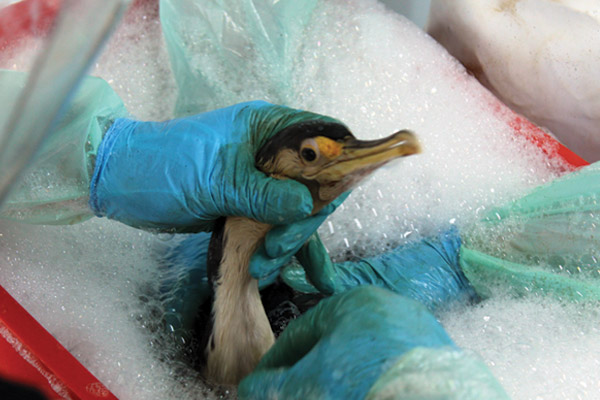 The Real Victims of Rena What happens when one of the richest wildlife habitats in New Zealand is hit with over 350 tonnes oil? One morning last October, Massey University vet Kerri Morgan woke to a call she’d been dreading. A container ship was grounded off Tauranga, holding 1,770 tonnes of crude fuel oil, all of which could potentially leak into the Bay of Plenty – one of the richest wildlife habitats in New Zealand. Having trained for almost 15 years, the National Oiled Wildlife Response Team, which Morgan leads, along with Helen McConnell, was be deployed to its biggest environmental disaster yet. The team was on the scene in Mount Maunganui within hours on October 6 and was able to begin washing the first oiled birds just two days later. Purpose-built facilities housed in a shipping container, and designed and built by Palmerston North’s, Bill Dwyer, formed the basis of the wildlife facility. Soon it became clear that more capacity was needed, and very quickly the facility grew into a tent city including triage, oiled bird holding facilities, a washroom, swimming pools and aviaries for clean birds, and pathology. At its peak the team cared for just over 400 birds, mainly consisting of little blue penguins, but also including shags, petrels, shearwaters, and 60 rare dotterels that were pre-emptively caught. A number of fur seals were also resident at the facility for a few days. Teams of wildlife responders led by the Department of Conservation and other trained personnel scoured the coastline for affected wildlife and brought them back to the centre for treatment. Members of the public were also instrumental in identifying oiled birds at the height of the spill. Kerri says a large team of trained oiled wildlife responders, including ecologists, Regional Council staff from around New Zealand, vets, bird rehabilitators and volunteers, were needed to guide the birds through the centre and back to full health. “Oiled birds that were brought in were checked by a vet to assess vital signs and administer fluids before they were put in a warm environment to stabilise,” she says. “The washing process takes a lot out of a bird so they needed to be rested and strong.” Once they were ready, a team of two then washed the birds individually. “One person held the bird while the other washed the oil out one feather at a time. It was a very time-consuming job.” Once clean, the birds had to restore their waterproofing, which required hours of swimming in pools and preening. Kerri says the logistics behind keeping up to 350 penguins and other birds clean, fed and happy was complex. “The birds needed to be fed twice daily, so we were going through a large amount of anchovies, which had to be defrosted at exactly the right time,” she says. “Penguins have to be fed by hand as they don’t eat dead fish on their own.” The birds also received regular health checks from vets, while another team kept the purpose-built aviaries clean. Kerri says the experience was a challenging, but ultimately rewarding experience. “The team has planned and trained for an event like this for a long time, and while you never want to have to put that training to use, I’m really proud of the way the team responded to the situation.” The Rena recovery operation is on going, and work is being carried out by a number of groups in the region to restore the environment. Donations can be made to the regional council’s Care for Our Coast fund here: http://www.boprc.govt.nz/sustainable-communities/bay-of-plenty-care-for-our-coast-fund/ Kerri will return to Massey with the New Zealand Wildlife Health Centre to continue her PhD and her role as a lecturer in avian and wildlife health. Much of her research is into ways to better care for oiled wildlife – she has recently published on preparedness for oiled wildlife response in the Antarctic, and is researching the use of salt-water washing for oiled wildlife. The centre also cares for sick or injured native birds such as takahe, kakapo and kiwi. It is currently fundraising for larger facilities. For more information visit: Bryan Gibson Wildlife.massey.ac.nz |
|
|

|