
|
|
Slow Travel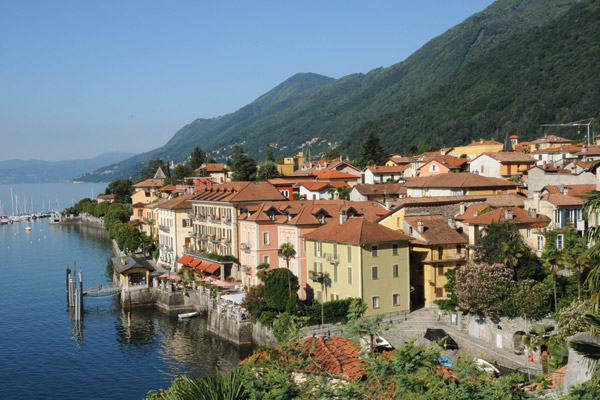 Slow TravelStepping back in time, Liz Light walks for a week in Italy’s Lake District. I trace our path over folds of the map and fret; the altitude lines between Lakes Orta and Maggiore are close together and I note a town called Alpino. There is, it seems, a mountain range to walk over. I wonder if I’m up to it, if my knees will last the distance, and what about blisters? There are daily walking schedules of around 15 kilometres and as I sit on my bottom at my computer all day I am not mountain-fit. Romans walked these paths 2,000 years ago, and shepherds have followed their goats and cows over these mountains forever. If bootless Romans can march for months I can walk for a week; it’s just a matter of putting one foot in front of the other! In the morning my anxiety has gone. Lake Orta is silver and the ancient monastery on its tiny island looks picture-pretty in a medieval way. We turn our back to it and head for hills with tops cloaked in cloud. Kath, my friend and the chief navigator, carefully reads the Inntravel walk notes and we soon leave the road on to a forest path. The vegetation is late-spring lush and the forest-filtered light is awash with green. I can almost hear the trees growing. I quickly learn to avoid nettles with leaves stretching to stroke our legs. Ouch! The old tale about juice from dock leaves easing nettle stings is true. The path, originally for horses and carts, curls gently upwards leading to Maisino, a village of cobbled lanes, stone houses, some with a plaster-finish painted with frescos - vines, flowers, stylised lions – and a piazza. We sit and ogle at the buildings around the square. The houses, both modest and grand, are 300-years-old, but are still homes for ordinary folk. We follow skinny lanes uphill, around a corner and grin at the pinch-me-I-might-be-dreaming 1566 church of San Rocco. The façade is decorated with statues of saints plus one of Jesus, so high up that only god can see it clearly. In the adjoining bell tower a cluster of bells are waiting to strike the hour, and steep steps lead to the solid wood door. The interior walls are intensely decorated with religious artwork, much of it as old as the church. In our antipodean world this is only found in history books. A lane behind the church leads to an open valley with small farms, where cows are knee deep in grass. Their low-toned bells dong gently as they move. Hamlets of five or six houses hunker into the hillsides. Some have magnificent vegetable gardens with fat cabbages, jack-in-the-beanstalk beans, spinach, tomatoes, aubergine and tall scraggly artichokes. We pass roses rambling over fences, hedges of pungently sweet jasmine and flowers – tiger lilies, petunias, geraniums – bright with summer. Farmland turns to forest and the walk notes take us alongside a river. The river warbles, cuckoos call (the same sound as my grandma’s cuckoo clock), misty warm rain falls and we walk on, losing track of time and kilometres. I’m tired, but not unpleasantly so. The sun breaks through just before we climb a steep zigzagging path to the hilltop Mesma Convent. There are chapels along the way, 12 of them, each with a fresco depicting Jesus’ journey, shouldering his cross, to the top of Calvary. It’s a long, hot, steamy climb for us and at each of the 12 stations we feel progressively sorrier for poor Jesus. When he finally got to the top of Calvary he was crucified. We drink fresh water gushing from a stone lion’s mouth, rest on a seat surrounded by flowering rosemary and eat chocolate, dates and almonds that we packed for such moments. It’s mostly down hill from here, back to Lake Orta –12 kilometres done, four more to go. These last four are the hardest. When we eventually stagger into our little hotel I’m hot, have sore feet and just enough energy to put on my togs and immerse myself in the lake. Ahhh, it’s cold, clear and just what my tired body needs. Later we summon the energy to stroll to Ristoro Olina, a restaurant where I relish a rich, four-course Italian dinner knowing that, with 17 kilometres on the map for tomorrow, I’ll use up every calorie. It’s the biggest and most delicious breakfast I have ever had, starting with fruit, moving to cakes, turning down the cooked breakfast but not the oven-fresh bread, with five different cheeses, olives, baby pickled onions and tasty tomatoes. This we wash down with fruit juice and rocket-fuel espresso. Despite breakfast, or may be because of it, I feel like crawling back into bed, not walking up to the flanks of Mt Mottarone and down to Lake Maggoire. The first hour or two is challenging. I feel weary from yesterday, the steep up-hill slog through a forest of larch, birch, oak and fir seems endless and Kath and I pretend not to hear the ominous rumble of thunder. The forest path joins a country road and when we reach this point lightening zigzags across the sky, thunder roars and the first fat raindrops fall. There is a shrine dedicated to baby Jesus standing alone above the road where we shelter while the storm rages. We sit on the step, drink water, eat chocolate and text home while terrifyingly close lightening and thunder bounces from ridge to ridge. The storm lasts an hour and through it all a tiny bird sits on the top of a nearby fir tree and sings louder than seems possible for something so small. The rain stops, the sun is hot, the road and forest are steamy and the air has a fresh after-rain smell. My morning lethargy is gone and I’m happy to be walking along the forest road, and happier still to enter the cobbled streets of Coiromonte. Being a new-country person I delight in medieval villages and in some of the old houses in this one goats are kept on the ground floor and there is a spring-fed open-air laundry with 10 stone tubs. The piazza is on a knoll with the church at one end. The church bells merrily chime the tune of “This old Man” to announce one o’clock. It would be nice to sit down and soak up the ambience but, ironically, the café is closed for lunch. The next four kilometres is through forest, skirting around Mt Mottarone. At times we walk paths, spongy with leaf litter, under a dense tree canopy. Other times the forest is more open and the path is edged with lush vegetation – blackberry, nettle, and summer flowers. Butterflies flutter from pink flowers – small orange ones, tiny grey ones and others with big speckled wings. And tadpoles scatter from the leaf-rot edges of a small pond when they feel our footfalls. Near little mountain streams we pass long-deserted farmhouses, their roofs fallen in but stone walls still strong. Large trees, now grown in inappropriate places, block doorways and grow in the middle of the rooms and up through the collapsed roof. This is the joy of walking, slow travel, having time to immerse the senses, to hear the birds, smell the flowers, watch the butterflies and truly be here. Stresa, a resort town on Lake Maggoire and home base for two days, is a different world to the quiet rural one in the hills above it. Grand turn-of-the-century hotels line the lakeside road and the Borromee Islands, four of them, with ancient castles and elegant old villas sit prettily not far from shore. The backdrop of snow covered mountains near the Italian boarder add to the picture, as does the vintage and beautifully varnished boats speeding tourists back and forth to the islands. This is a place to see and be seen, and is proud it has been so for centuries. Napoleon and Josephine stayed in the palace on Isola Bella as did Charles and Dianna, and Earnest Hemingway recuperated in the still-Grand Hotel after the First World War. Stresa is too good to miss so Kath and I choose a lay-day instead of the Inntravel walk in our programme. We explore the islands, tour through the bottom two floors of the castle (the Borromeo family still use the top floor as their summer residence) and explore the 10 tiers of its statue and fountain-filled formal gardens. We have lunch in a waterside restaurant, snooze in the heat of the afternoon, cruise the shops in the early evening and have dinner in the piazza. It’s a day full of palaces, shops, boats and full-on tourist bustle. At the end of it we are ready for the slow lane again and are looking forward to walking for three more days through the quiet Italian countryside. Liz Light lizlight.co.nz Fact file. Getting there: Cathay Pacific flies from Auckland to Milan via Hong Kong every day. www.cathaypacific.co.nz Walking holidays: Inntravel features 85 independent walking holidays in Europe providing something for everyone, from gentle coastal strolls to high mountain hikes. An Inntravel walking holiday includes accommodation, walking maps and notes, luggage transfers between hotels, breakfasts and some dinners. Inntravel arranges train travel to and from Milan. www.inntravel.co.uk Liz Light lizlight.co.nz |
|
|

|