
|
|
Something About Alice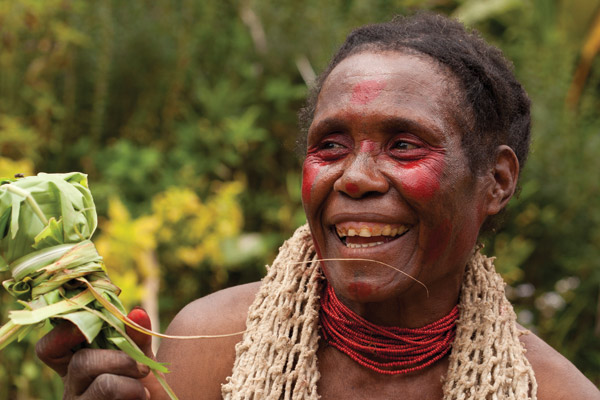 Faces streaked in paint, wearing grass reed skirts and loosely woven fabric over their breasts and heads, three solemn young women stand obediently inside their village gate. One holds a sharp knife; its pointed end facing upwards with red paint at its tip symbolizing blood. Next to her, more easily explained because of unexpected down pours, the girl holds an umbrella. By Kelly Lynch The third woman’s face, neck and arms are caked in white clay. She is in mourning and how long she’ll remain like this depends “how deeply [she] loved her husband,” she says. Her words are interpreted through Alice, a woman from the same village who is helping me understand daily life for women in remote Papua New Guinea. From the air Papua New Guinea’s southern highlands are a mass of verdant jungle randomly separated by deep treeless craters and bounding waterfalls pouring over precipitous cliffs. Carved out of a hillside, 2133 metres above sea-level, hundreds of deep trenches and high mud-block walls enclose clusters of thatched roof huts; their sides woven from wild sugar plants. Tari, blessed with warm days and cool nights, is home to the proud, feisty Huli people. Alice has worked for 14 years at Ambua Lodge. Just out of town its comfortable naturalistic accommodation has views beyond manicured gardens to mountains numerous and undulating. David Attenborough and the BBC film crew stayed here when they filmed some of the 13 Birds of Paradise and their unusual antics in the Tari Gap nearby. Birding guides take early morning and late evening twitcher tours from the lodge into adjacent bush and rainforest passed waterfalls and cane-constructed bridges. Under lofty shade where birds rest, Huli men share their face painting, wig making and spirit dances with visitors. They also demonstrate village life, how to fire bow and arrows and make fire. Alice, a proud Huli woman, was always surprised to hear guests report the wide-range of chores carried out by men. “They don’t tell it right,” she says and in a strictly male dominated society she made a bold move inventing a ‘womens tour’ in her village. Alice tells us the messenger woman carrying the knife and umbrella is a role usually resigned for middle-aged woman; their average age of life expectancy is 60-70 years old. Sent by her village to the market, her task along with another female, whose face is painted in war stripes, is to signal their village’s grievance, most likely over land or women, with another. Because of its seriousness they are to abstain from sex and visit the market every day until compensation is paid in either pigs or kina, (local currency). And if it is not, tribal war will likely ensue; police intervention is rare leaving clans to sort out their own issues, often in merciless ways. Abstinence is not unusual in Tari, until recently men and women ate, cooked and slept in different huts, only sharing their bed mats for baby making. Traditionally children grow up with their mothers and at the age of 10 boys move across to their father’s quarters; Alice thinks today about 60 per cent of couples in Tari share matrimonial homes. Ahead on the pitted mud track, a woman wearing a grass skirt and a woven beanie, her face faintly tattooed in line and zigzag patterns, carries a bilum bag, Papua New Guinea’s answer to an all-purpose carry bag. Being hands free, it’s two loose ends tie together in a knot so as to rest on top of her head, its weight falling down her back. Inside the bag on a banana leaf mattress, a chubby baby objects as his mother sponges him down with moist moss like a baby wipe. There’s a medical clinic in Tari, but it is not unusual for women, with family assistance, to give birth inside their huts. Afterwards mothers are forbidden to toil in the garden as are menstruating women who are also barred from food preparation, sharing a bed and speaking with their husbands. To the left high mounds of dark rich dirt, smelling very earthy, sprout leafy green vegetables. After a spate of hard shoveling one woman takes a bunch of sweet potato roots in both hands and energetically throws herself at the mound punching the roots deep into its core. Complementary vegetables like corn and carrots are also planted in the same mound. A pig eagerly pulls on its tethered rope; having broken large lumps of dirt with its snout it now wants to reap any benefits. Pigs, a family’s number one commodity, are money in the bank. They continue to be used in bride negotiations; the average bride price, depending on size is 30 hogs. Divorce settlements are tough, whichever party wants to leave must compensate the other; Alice says her divorce cost her and her family 31 pigs. Unappreciated by these women it’s common for men to take two to three wives. In a land where women’s voice is seldom heard, their path of resistance is set in sorcery. Sweet potato leaves, red paint and bush fan is rubbed together and cut in half as a witch softly chants, “Cut through his mind, right down to his toes, forget about the girlfriend, do as your wife says and follow her around like a puppy dog.” Walking between huts there is no sign of rubbish; possessions are few and those such as pots are neatly stacked in a corner. Behind the homes on a grassy bank an older woman sits cross-legged weaving a bilum bag. She explains the material is stripped, dried and twisted bark threaded together by the bone of a cassowary bird. A young girl watches the demonstration and our attention with curiosity. Slowly women gather around sitting on a wooden bench. I glance over from a display of handcrafted necklaces, hats and bags and share unguarded moments of a girl scratching her mother’s back while another two women share a private joke, chuckling. These women, the backbone of their clan share their trials, as well as a closeness and ease earned by those who live and rely on each other in such remoteness. Kelly Lynch INFO Ambua lodge is operated by Trans Niugini Tours, which owns a number of lodges in PNG, accessed by their own planes and vehicles. They offer packages including transfers, accommodation, meals, tours and excursions. See www.pngtours.com Pacific Blue has daily flights from Auckland to Brisbane connecting to Port Moresby, Papua New Guinea’s capital. www.flypacificblue.com Air Niugini has regular flights from Port Moresby to Tari. www.airniugini.com.pg At arrival at Port Moresby a tourist visa must be purchased for $56. The local currency is kina. |
|
|

|