
|
|
Julia DeVille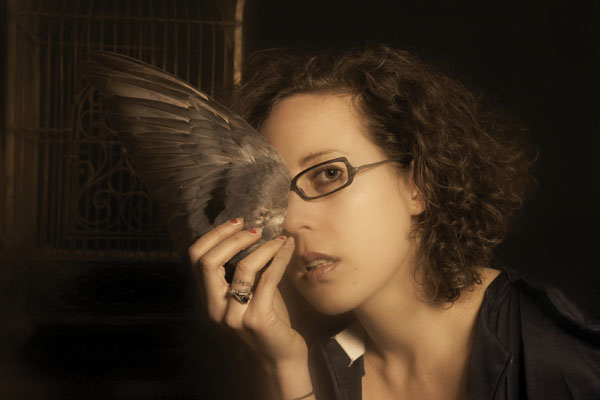 Alternative New Zealand-born artist, Julia deVille is creating new life with death New Zealand-born accessories designer Julia deVille is eccentric to say the least. Working with gold and silver, wood, taxidermy and even human hair the fascinating artist produces eerie yet inviting designs from her Melbourne base. Paying tribute to Victorian mourning jewellery and Memento Mori (reminder of our mortality) jewellery of the 15th-18th centuries, Julia’s work is identified by the use of symbols of death in her pieces (everything from skulls to the dead animals she taxidermies herself). After a brief stint studying fashion and subsequently footwear, Julia studied gold and silversmithing and ultimately combined her jewellery design and taxidermy to establish her label DISCE MORI (Latin for Learn To Die). Deville, a name she concocted during a television interview a decade ago, now has a full range of jewellery — rings, bracelets, brooches, necklaces, cuff links, key fobs — as well as leather gloves and spats, and even exhibition pieces. The result? Dark, sterile pieces with an obvious ‘goth’ feel. “I incorporate the symbols of death throughout my work because I think it’s important to identify with the concept that we are in fact mortal creatures,” she explains. “The nature of our culture is to obsess over planning for the future, however, in doing so we forget to enjoy the present.” Julia’s interest in life and death emerged early. As a child she dressed up in her grandmother’s fox-fur stoles, where the mouth opened up to bite its tail. She was fascinated by the idea that this creature was once living. Her parents were very open to the idea of death and when relatives passed it wasn’t taboo to see them or touch their bodies. The Wellingtonian bought her first piece of taxidermy at age 15, and while living in New Zealand she approached several taxidermists for mentoring, but wasn’t taken seriously. It wasn’t until she moved to Melbourne in 2001 that she met a retired taxidermist who offered to take her on. After half a dozen lessons Julia began experimenting herself and has since perfected her practice. “When I first started out taxidermy was definitely not popular. It was a conversation stopper – people thought I was weird.” But Julia recalls her first time as ‘beautiful’. “I took a little starling I had found to my mentor who took me through the process. I wasn’t sure if I’d be squeamish, and it was beautiful. Once we skinned the bird it was like a small chicken; not unfamiliar or frightening and it didn’t smell because it was fresh. From then on I was comfortable with it.” Julia’s jewellery is priced from $200 and diamond engagement rings can go for anywhere up to AUD$20,000. Her artwork starts at $2,000 and goes up to AUD$80,000. “I consider my taxidermy to be a celebration of life, a preservation of something beautiful,” she says. “I feel strongly about the fair and just treatment of animals, and to accentuate this point I only use animals that have died of natural causes.” To prove her dedication to her art form Julia wants to donate her body to Germany’s renowned Institute for Plastination. If she goes ahead her body will be dissected, filled with a special polymer and preserved for exhibition after her death. “As a society we spend most of our time thinking about the past or projecting into the future. The only moment that actually holds value is this moment. I use symbols of mortality in my work as an anchor into the present, a reminder of the importance of life. “The whole theme of death is something that grabs you out of the insanity of life, and reminds you that we’re all going to die so we should make the most of our lives instead of worrying about the things we have no control over.” Julia has exhibited at the NGV, MCA, FIT (Fashion Institute of Technology in NYC) and has a permanent installation (The Cinerarium, a real burial ground) as well as another work in the collection of MONA in Hobart. However, following the recent completion of this project Julia may rethink her planned plastination. “If there’s a way I can send half of my body to Germany and the other half to MONA that would be ideal,” she quips. “But at the end of the day I don’t care what happens to me. I know that the body is nothing when it’s dead, but I think it’s appropriate that I end up in something that I’ve created.” Her next series of works for the Sophie Gannon Gallery are sculptural pieces that are themed around a much stronger animal rights point. Stillborn calves, deer and lambs join chickens and a dog for the exhibition that aims to highlight the way we give preference to certain animals. “If a dog was treated the same way as a battery chicken or pig the owner would go to jail, but it’s legal for farm animals, which are just as intelligent and feel pain just as strongly from being treated inhumanly for a profit. “Most people buy free range eggs but won’t think twice about buying a tub of ice cream that uses battery eggs. It’s simply unawareness and I’m using this platform to talk about something I feel very strongly about.” juliadeville.com Five even more interesting facts about Julia deVille: - She has two dogs: Chilli and Scout, and she plans to taxidermy them both – hopefully not for a while yet. - She is a vegetarian. - She does yoga 10-12 hours a week and has done so for the last seven years. “I value it as much as my work. Everything is planned around my yoga.” - She was delivered by Kerry Prendergast, former mayor of Wellington. - She has a tattoo on her face of an ornate hibiscus that comes down from her ear along her upper cheekbone. |
|
|

|