Power Profile > Sacha McMeeking: Change Agent


|

|

|
|
|
|
Sacha McMeeking: Change Agent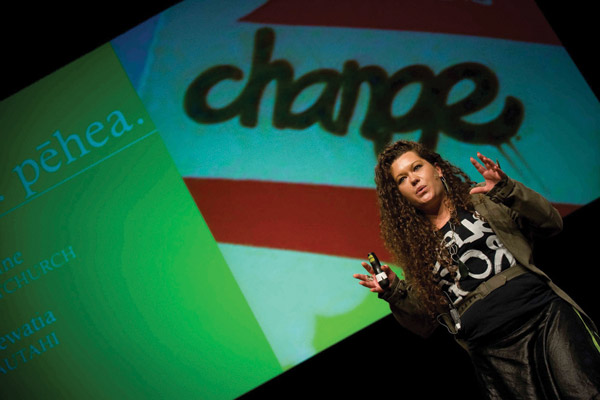 Catalytic, adj. an action between two or more persons or forces, initiated by an agent that itself remains unaffected by the action. By Nakita Ardern Catalytic … quite an apt description for a business birthed by one of the great change agents of our society. Of Ngai Tahu descent Sacha McMeeking once believed that the law was the way to change the world. She now believes that the most effective way to make your voice heard is to create solutions. “The answer ‘no’ is like a dead end that means no one has much room to move. The answer ‘no, but have you considered the X, Y or Z alternative solutions’ creates the space for solution building that meets the maximum suite of interests,” she explains. The soft spoken 34-year-old is principal of Catalytic; a boutique consultancy providing expert advice in government relations, public policy and corporate social responsibility, and strategic support in relationship management and Iwi development and governance. Over time she worked her way to General Manager of Strategy and Influence with Te Rūnanga o Ngāi Tahu where she was responsible for leading the external affairs portfolio for the Iwi spanning government engagement, public policy, brand and reputation. Through this role her accomplishments include designing the international advocacy strategy concerning the 2003 foreshore and seabed reform, which resulted in the first successful human rights complaint concerning Iwi being upheld by successive United Nations (UN) bodies, developing a comprehensive corporate social responsibility framework and toolkit for Iwi and Māori organisations and negotiating a number of pioneering outcomes with government. Her pre-eminent work with the foreshore and seabed debate started in 2004 when the Court of Appeal decision first came down and the Labour government of the day was working through what its options were to respond to its decision. Sacha wasn’t long out of law school and firmly believed the policy direction from the Labour Government was discriminatory. She was fortunate that the tribal leadership were up for taking a punt on a young graduate with reasonably audacious ideas. “Taking the UN pathway was about putting a stake in the ground,” Sacha explains. “We knew that the Government wouldn’t necessarily listen to the UN, but it would provide a platform for the issue over time. Ultimately the findings of the UN were the key platform that the National Government relied on to change the legislation. “In one sense it was a success, but the race relations within New Zealand will be an ongoing process.” In November 2005, Sacha joined a voluntary ad-hoc Maori organising committee formed to ensure Maori participation in the visit to New Zealand by the UN Special Rapporteur on the Situation of Human Rights and Funadamental Freedoms of Indigenous Peoples, and in 2006 she was awarded the Ngata Centenary Doctoral Scholarship at Canterbury University. “I’m definitely mission driven. I started off life thinking I would be a lawyer doing international human rights advocacy, then four years ago in my role with the Iwi I really got into researching different ways of achieving outcomes. I was fascinated by ways to use a business venture to solve problems.” Around 2009 Ngai Haua was set to lose significant value on some of its assets so Sacha and her team set about finding creative ways that the Iwi could insulate itself from losing millions. “The first thing we looked at was how to use a business venture to stop some of that value loss. We looked at a carbon farming business venture partnership. This was my first experience seeing how business could be creative and solve problems.” Recognised as an emerging New Zealand leader, Sacha was the inaugural Fulbright Harkness Fellow in 2010, which she refers to as “one of those remarkable life-changing experiences”. Based at North Western University at the Kelloggs School of Management Research Sacha researched how different tools that are used globally could help Iwi make commercial decisions according to traditional values. “The real value of the fellowship was getting to the United States and appreciating that there was more than the horizon of the possible that existed for me. It wasn’t quite an epiphany; rather realising the realms of the possible becomes much broader. Meeting with social entrepreneurs I learnt there is an entirely different side of business I had never thought of. I was inspired by the commitment through business models to create environmentally and socially good outcomes.” Sacha returned to New Zealand at the beginning of 2011 with notions to start her own social enterprise initiative when the February 22 earthquake hit, derailing her plans. She was fortunate not to loose her South Brighton home. The shake up presented a viable opening to launch a non-profit start up, The Ministry of Awesome, which she founded with Sam Johnson, founder of the Student Volunteer Army and Young New Zealander of the Year 2011, Vicky Buck, former Mayor of Christchurch and Kyla Colvin, who curates the independent TED events in Christchurch as well as being a serial entrepreneur. The Ministry is all about helping people in Christchurch do creative things in the city that brings them delight and contributes to the recovery journey. Sacha is also currently exploring starting up a social enterprise around market mechanisms to create environmental and social outcomes. “I’m constantly surprised that the world isn’t as organised as I expected it to be and I’m learning to appreciate that everyday people are making things up in real time, which is creating enormous openings for people with solutions.” The thing that has changed over time is my level of understanding. It’s happened in three stages: First, I inspired young people that process movements were the way to change the world. Second, I started to see the art of lawyering and advocacy was the way to change the world. And over the past five years I’ve started to appreciate, as important as protest movements are to articulate the nature and extent of rights, there is real power in being an imaginative solutions builder.” www.catalytic.co.nz If I were Prime Minister for a day, what would I change? It would have to be a reasonably long day … 1. Ways that real people can contribute to the thinking and the direction of the country would be the first order of the day. To start with I would quite like to change the democratic institution. The world is changing towards people wanting greater participation in the development of laws and policies. 2. Create a green growth strategy for New Zealand. Green growth is a recipe for economic growth. 3. Create a social enterprise venture capital fund. Doing good by doing business rather than doing good by small philanthropic funds. Social entrepreneurs having access to funds to get good businesses off the ground. 4. Hard to achieve in a day but in the context of the Treaty relationships I’d try and start a conversation around this. I’ve worked for Ngai Tahu in various roles and for that entire time we’ve been in our post- settlement stage. One of the challenges with the way that the country is grappling with Treaty issues is that the post-settlement stage isn’t disciplined. We’re stuck in arguments of various rights. 5. On a totally selfish level I’d really love to go to dinner with Kim Hill. I think she’s amazing and the quintessential generalist. |
|
|

|