Power Profile > Free Radicals


|

|

|
|
|
|
Free Radicals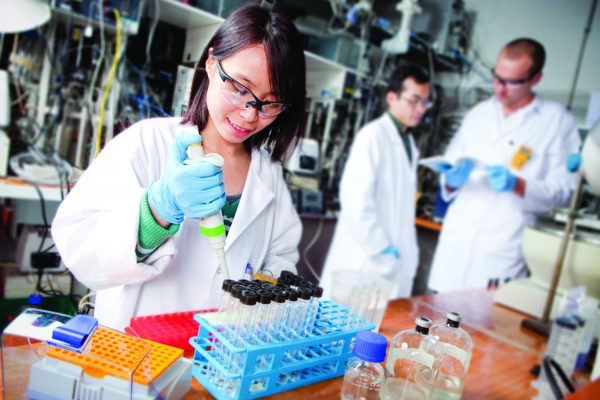 Free Radicals Take New Zealand’s scientific community and you’ve got yourself a small but very capable crowd. Now take out all those with a Y chromosome and the number reduces dramatically. Recognised internationally for their contributions to science, two quiet achievers from New Zealand’s foremost female minds in science demonstrate the power of positive thinking in some less-than-accommodating environments. Professor Christine Winterbourn, MSc (Auckland), PhD (Massey), ONZM, FRSNZ Director of the Free Radical Research Group A cheeky smile flickers across the face of the country’s top scientist, Professor Christine Winterbourn, as she ushers me into her tiny office. “Welcome to the locker room,’’ she says. She’s not kidding! The 2011 Royal Society Rutherford Medal winner actually works from a locker room. She shares the tiny room, dominated by storage units containing lab coats and co-workers’ belongings, with a colleague from the University of Otago as a part of Christchurch’s Free Radical Research Group. Christine Winterbourn is working from these temporary premises because the earthquakes damaged her usual office. But her good-humoured acceptance of the hot, cramped, makeshift office is typical of her unassuming, hard-working style. Christine’s colleagues describe her as an impressive combination of exceptional intellect coupled with an exemplary work ethic. But it’s not just colleagues who appreciate this quiet achiever. The Royal Society of New Zealand recently awarded Christine the country’s top science and technology honour, the Rutherford Medal. She is the first woman to receive the medal in its 20 year history and recognises a career spanning 40 years. In 2004 Christine received the highest research award from the University of Otago, the Distinguished Research Medal, along with being awarded an Anniversary Medal from Massey University where she completed her PhD. These awards add to others she has received from the Royal Society and the Government over the years. The President of the Royal Society of New Zealand, Dr Garth Carnaby, says Professor Winterbourn received the Rutherford Medal because her work in free radical biology paved the way for ground-breaking research into links to diseases. “Professor Christine Winterbourn was one of the first scientists to demonstrate that our cells produce free radicals as part of their normal function. She went on to characterise some of the chemical reactions of free radicals that we now know occur in diseases such as cancer, stroke, coronary heart disease and arthritis,’’ he says. “Her mana extends well beyond New Zealand’s shores. She is recognised internationally as one of the founders of free radical research in biological systems and a leading world authority in this field.” “Professor Christine Winterbourn has also been a firm advocate for science in New Zealand, and has also been an excellent mentor to numerous students and young scientists trying to forge careers in New Zealand.” Most of Christine’s career has been spent at the University of Otago’s Christchurch campus. She came to Christchurch in the early 1970s after doing a Master of Science at the University of Auckland, a PhD at Massey University, and working as a post-doctoral fellow in Canada. Christine began working with Professor Robin Carrell, who was then head of Clinical Biochemistry at Christchurch Hospital and later a Professor at the University. “It was a very stimulating time for me. Professor Carrell was prepared to ask the big questions and there was a sense of creativity and freedom of scientific inquiry.’’ “Professor Carrell always said there was no reason why we couldn’t make remarkable discoveries in New Zealand and that made a big impression on me. I still think that.” With Carrell, Christine did make some remarkable early discoveries in the field of free radical research. “We were studying haemoglobin, the red blood pigment that carries oxygen around the body. We were looking at a patient whose haemoglobin contained a genetic mutation and we were interested in understanding why this caused her to be anaemic. We found that her protein converted some of the oxygen to superoxide radicals, to a much greater extent than normal haemoglobin. This was one of the first demonstrations that free radicals are generated in cells. It helped open the realisation that free radicals are continually being generated in our bodies and that we need protective anti-oxidants to control them. This discovery stimulated my interest in what superoxide radicals do, and set the direction of my subsequent research.” Christine’s research over the years has made a major contribution to knowledge about how free radicals and other reactive oxidants are produced in the body, what damage they cause and how the body protects against them. Her Free Radical Research Group has developed tests to detect production of oxidants in different diseases. For example, superoxide radicals and chlorine bleach are produced by white blood cells to kill microbes that enter the body. Christine and her colleagues have characterised how this occurs, and shown that the bleach can sometimes damage host tissue. One situation where they have demonstrated this occurs is in the immature lungs of premature babies who need to be on ventilators, with greater oxidative damage being associated with poorer lung function. Assessment of how different treatments affect the level of injury enables the development of procedures that improve the outcome for the infants. Christine says, “Nowadays, free radicals and anti-oxidants are terms many people are familiar with because we are told to eat our fruit and vegetables because they are rich in anti-oxidants and they protect against free radicals. When I first started work on free radicals the term was common in chemistry, but the idea that free radicals might have an important role in health and disease was relatively untouched.” Another transformation over Christine’s career is the presence of far more women in science and senior research positions. In her acceptance speech Christine summed up why she felt it had taken 20 years for a woman to receive the Rutherford Medal. “I thought about why it has taken this long, as people often bring up discrimination – but I don’t think it’s really that. There are obstacles for women to overcome, but a lot of it is statistical. Obviously, the recipients are fairly mature individuals, and started their careers when women scientists were much the minority. For example in my MSc chemistry class, we were four of about 30. It is very different now, and I am sure I’ll be the start of a trend. “Probably what was more of an issue for me in the early days was being a scientist in the medical world. Back then it was usual for the Medical Research Council (which later became the Health Research Council) to give grants to medical staff and they would employ a scientist to do the work. We were seen as ‘support staff’ rather than leaders in our own right, and we were almost an invisible group within the University structure.’’ This situation has gradually changed. Christine’s success in attaining her own grants over the years helped provide projects for up-and-coming researchers to work on. “I was really fortunate in that three of my PhD students (Professor Tony Kettle, Associate Professor Margreet Vissers and Associate Professor Mark Hampton) have stayed with me and become independent scientists. Together our work has evolved into the Free Radical Research Group (FRRG),’’ Christine says. “The Free Radical Research Group developed gradually over the years, but has become really big in the past 10-15 years.’’ Today, Christine leads a group of about 25 researchers who make up the FRRG. “We work together very much as a group, and I think that’s important for the successes we’ve had. In New Zealand it’s a small scientific community and the Christchurch community is even smaller. So it’s really important to have a critical mass, not only for strength in numbers for getting the resources you need but also to have people to bounce ideas off.’’ In her Rutherford Medal acceptance speech Christine urged young scientists to follow their dreams, as she had done. “Science is an exploration ... be curious and excited on a day-to-day basis. A lot of major advances have come when people are trying to satisfy their own curiosity and their own burning interest". "Science is unpredictable – you never know what direction it's going to go. This is certainly true of research, but I think it is also true of careers. People often end up in a direction that they never anticipated at the start. I know a lot of young people agonise long and hard over what do, but my advice is make the best decision you can at the time ... and see what happens!” “I have enjoyed my life with free radicals and I hope I can keep instilling the value of curiosity in the talented people who work with me.’’ Gillian Wratt Former CEO, Cawthron Institute There are probably not many CEOs in New Zealand who can claim to have paid more than 50 visits to one of the world’s most far flung outposts – Antarctica. But for Gillian Wratt, who recently finished her posting as CEO of the Cawthron Institute, trips to the Southern Ocean were an integral part of her career path. This Motueka-born scientist remembers her first trip to Antarctica in the mid 1980s as one of the only female field assistants in a research programme in the ‘Dry Valleys’, a 30-60 minute helicopter ride from Scott Base. She was working with scientists from the Department of Scientific and Industrial Research and representatives from the University of Auckland. For three months the group lived in tents and field huts on the world’s coldest desert as they conducted research into the microscopic-organisms that grow in the lakes and glacial meltwater streams there. The highest, driest, windiest, emptiest, coldest place on earth more than met the enthusiastic 30-year-old’s expectations. “When you imagine Antarctica, the first things that come to mind are snow, ice and penguins, but it was so much more than that,” Gillian remembers.“My most memorable experience was sharing the 40th birthday of a colleague on my very first trip. At midnight we walked to the top of the peak where we were doing our research programme. At the high point overlooking the sun deep on the horizon, celebrating with some good friends in one of the most amazing places in the world, was unforgettable. “People think of Antarctica as an out-there extreme environment, and it can be,” she continues. “I’ve been at Scott Base at times when there’s a blizzard blowing and to go from one building to the next you need a rope between the two. But generally, through the summer it’s not blowing a blizzard and its daylight all the time, it never rains and you have the right kit for the conditions. The times that I’ve felt most in awe of the environment is on the ship in the Southern Ocean. If you’re halfway between New Zealand and Antarctica in a storm, it’s a very small ship in the middle of a very big ocean. It’s a truly awesome experience.” From New Zealand, the rousing journey takes five-eight hours by plane from Christchurch or about a week by ship, so what is the appeal for some of the world’s most inspired minds to take themselves so far out of normality? “There are amazing and fascinating opportunities to do research because of the environment there,” Gillian explains. “To understand how things live there, the environment, the geology, atmospheric conditions as well as climate change-related research, and to look at the potential impact of how warmer global temperatures affect the ice sheet. You can also understand things about the global environment working in Antarctica. If you’re seeing effects from things like pollutants in the atmosphere from human activities in the northern hemisphere, it really brings home that the human race is impacting on the global environment.” After her first trip Gillian caught the travel bug and it wasn’t long before she got her next taste of life on ice. “At that stage I was working for another part of a Governmental science organisation and I went back to my job there. I subsequently won a study award to do an MBA and was Convenor of the Establishment Board for the Crop and Food Research Institute. Then the job for the director of the Antarctic Programme came up. I’d been to the Antarctic and enjoyed it so thought that would be a good job for me – I had a unique combination of science, environmental and international connections.” Over the next decade Gillian served as Chief Executive of Antarctica New Zealand and Chair of the International Antarctic Managers Council. Furthermore she has served as a Trustee for the New Zealand Leadership Institute, been a Board Member for the Natural Step New Zealand (TNSNZ), is a member of the New Zealand Institute of Directors and New Zealand Institute of Management. Gillian is now on the board of the Environmental Protection Authority; a Government agency responsible for environmental regulation in New Zealand. Amongst this work Gillian was able to return to Antarctica from South America on several occasions, with a ship-based tourism company guiding and lecturing about 50 people on a converted Russian research vessel – and all the while indulging in her love and talent for kayaking. Gillian organised the New Zealand women’s kayak expedition to Sikkim, India in 1991, was crowned the New Zealand Whitewater Kayak Slalom champion, and was in New Zealand Whitewater Kayak team in 1987. Gillian has received many accolades throughout her career including Member of the New Zealand Order of Merit (MNZM) for services to Antarctica – Queens Birthday Honours 2004, Chair of the Council of Managers of National Antarctic Programmes 1998-2001, Vice Chair Antarctic Treaty Committee for Environmental Protection 1998-2001, Chair of the International Association of Antarctic Tour Operators Annual Meeting 2003, 2004 and 2005 and she was a recipient of the New Zealand Suffrage Centennial Medal in 1993. Gillian holds a BSc (Hons) in Botany from the University of Canterbury and an MBA, from the Graduate School of Management and Public Policy at the University of Sydney. Reaching the end of her five year contract as CEO for the Cawthron Institute, Gillian was offered an extension and decided to extend for only one year; finishing up in March 2012. "I have mixed feelings about moving on – Cawthron is a very special organisation. Owned by the Cawthron Institute Trust Board, it is New Zealand’s oldest and largest independent research institute. It sits at the critical intersection of science, business, community and the environment. It makes an important contribution to the region and to New Zealand, and has a wonderful group of highly-skilled staff. I have been privileged to be Chief Executive for six years, and I will be sad to leave. The Institute is in good shape, and now is a good time to move on. I have other interests I want to pursue, and I would like to do some of these sooner rather than later,” she said. “One project I have been asked to take on is to write a book on the organisations across the world that manage science and operations in Antarctica – a different challenge to leading a research institute.” Remaining in Nelson, Gillian is looking forward to indulging in ‘spare time’ and will be leaving her options open for whatever may come her way. Ian Kearney, the Chair of the Cawthron Board of Directors, has nothing but praise for the lasting impact Gillian has made on Cawthron. “Gill has provided clear leadership and vision that has established a forward path for Cawthron,” he said. “This is reflected in achievements like the new buildings at the Glen, growth in staff from around 150 to 200, and significant recognition for Cawthron's science both nationally and internationally.” Thomas Easterfield, the Cawthron Institute’s first director, must have known he was setting the bar high in 1917 when he said, “I foretell a brilliant future for this institute to be a centre of light, learning and culture, honoured throughout the civilised world and a lasting tribute to the memory of Thomas Cawthron.” The Cawthron Institute officially opened in Nelson in 1921, and 91 years on Gillian says it continues to succeed in its founder’s aims. The institute has become one of Nelson’s larger employers and its focus has also changed. Cawthron staff initially sought a cure for bush sickness, a livestock wasting disease, and were busy eradicating pests affecting crops and generally providing research for the country’s land-based industries. Today it has three main research and business streams: aquaculture production research that is mainly shellfish-related; environmental research and consulting; and an analytical laboratory that does environmental testing and tests food exports for product label claims and integrity. “A well cared for environment is important from a spiritual, as well as a health, lifestyle and economic point of view. Our way of life depends on a range of environmental services. Cawthron works at the intersection between business, the environment, community and science helping environmentally-friendly operations.” Kim Thomas www.uoc.otago.ac.nz |
|
|

|