Power Profile > My tolerance for discomfort enables me to pioneer


|

|

|
|
|
|
My tolerance for discomfort enables me to pioneer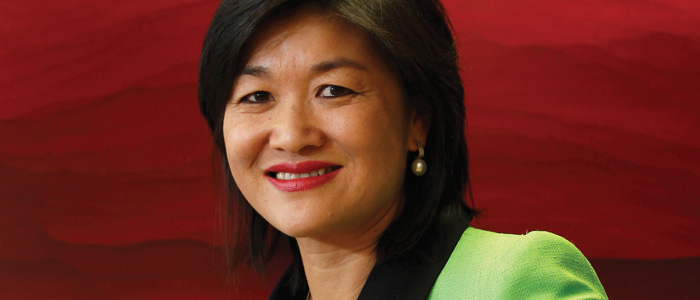 As Auckland steadily approaches a statistical high of 200 ethnicities in its workforce, Chen Palmer Founding Partner, Mai Chen, believes employers must master diversity by acknowledging the value of difference in order to thrive and survive. “I would never ask my staff to be the same,” Mai, a Taiwanese migrant explains. “I acknowledge that if I want to win in a competitive market place may mean seeing things from a different perspective or having new and fresh ideas.” Over her 27 year career, 18 with Chen Palmer, Mai has come to recognize that people from diverse backgrounds are ‘tougher’ than those from majority groups. “They’ve often had to struggle to get where they are. They tend to be more resilient and have learnt to use a range of different mechanisms to get where they are. Generally, the conventional powers are cut off to them; they don’t have (in lawyer language) ‘daddy’s firm’ to fall back on. They are usually the first lawyers in their family. They didn’t go to traditional schools (like Kings or St Cuthberts) so they’ve had to use a range of networks and skills. I tend to think those from ethnic minorities who have made it far in the legal profession are pretty able.” These minority groups, Mai believes, add to the richness of what a firm can offer its client base. “We as lawyers must empathise with our clients. It makes us better lawyers if we understand what people are going through and their different walks of life.” Given Mai’s own background, creative problem solving is something that has become second nature to her. With the Chens arrived in New Zealand, neither Mai, her parents nor her three sisters spoke much English and they lacked the connections of family and friends to help them make inroads here. “My parents had $200 USD and four children under 12. I spoke two words of English – watermelon and elephant.” Today her success can be attributed to early determination. Mai is adamant that success goes to those who are used to a high level of discomfort. “You watch Sesame Street and you learn,” she says, “Success in the current environment doesn’t go to the strong. It goes to the adaptable. I’ve done that all my life. My tolerance for discomfort enables me to pioneer.” Mai also understands that it is not just about employees who are from these diverse groups…her firm's customer base is also increasingly diverse. “There are so many clients that I have advised that haven’t considered tapping into the Asian market. This is silly when, in Auckland 19% of the population is Asian. That’s nearly one in every five. If you look at the Statistics New Zealand projection for 2021, that tells us that over 27% of the population in Auckland will be Asian, 17% will be Pacifica and 12% will be Maori. When you add those up the minority becomes the majority. Over half your market will be either indigenous or an ethnic group. Diversity is often about minorities. Well I’m telling you that these minorities are about to become the majority in New Zealand’s biggest city.” To prepare the leaders of tomorrow for this growing market group Mai has recently established AsiaNZ CEO. Whilst organizations like the New Zealand Chinese Association and the New Zealand Korean Association serve a worthy purpose, AsiaNZ CEO is focused on training New Zealand Asians who want to break through and become top leaders. It also profiles top Asian NZ leaders so companies doing business in Asian can benefit from their expertise and experience. “I was continually being approached by Asians in middle management or individuals aspiring to be CEOs who were always being looked over. Sometimes it was purely discrimination but I found more often than not it was because they were immigrants and they lacked the mentors to help them navigate the system. Never underestimate who you have on your CV when you are seeking to become a top leader. I decided that since I could not help each of these people individually I set up an organisation called AsiaNZ CEO. Its three purposes are, first, to train emerging CEOs to break through the bamboo ceiling. Second, to ensure that Asian CEOs in New Zealand can come together in a group and share wisdom with each other as well as mentor up and coming CEOs. And third, to ensure that those Asians in New Zealand can help companies here succeed in Asia because of their language and cultural skills and their family connections. “So often when I am asked to speak on diversity they’re talking about getting women into their business. That’s very 20th century. In the 21st century we need to acknowledge that the most discriminated against groups in our society are often Asians, Pacific Islanders, Maori and the disabled. “New Zealand wants so much to walk the talk. We’re talking about it but not maximising the full potential of our local Chinese community. There are so many Asians proud to be New Zealanders. They don’t want to be in their home countries. They want to live and contribute here. “I love the Rule of Law in New Zealand. I love the clean, green. I love the weather. On top of this, I get all the benefits of living in a Pacifica/Asian city.” www.chenpalmer.com |
|
|

|