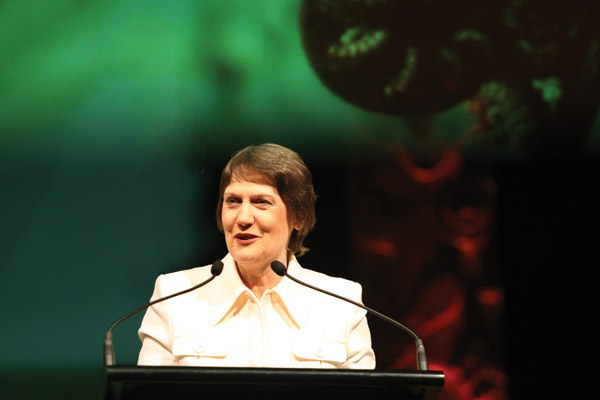
Helen Clark became the Administrator of the United Nations Development Programme in April 2009, and is the first woman to lead the organization. She is also the Chair of the United Nations Development Group, a committee consisting of the heads of all UN funds, programmes and departments working on development issues.
You have been Administrator of the United Nations Development Programme (UNDP) for over three years now. With one year left in the role, how are things looking? Have you achieved everything you set out to do?
I am determined to leave UNDP a more effective and nimble organization, which can respond well to today’s increasingly complex development challenges. To that end, I began a change agenda to lift the organization to even higher performance. We are making good progress and will make more over the coming year.
What has been the highlight of your New York posting so far?
Being in New York gives one access to what amounts to a permanent festival of arts and culture. That makes it a very attractive location for me! But I also travel widely around the world to countries which I would otherwise never have had the opportunity to visit. I have great admiration for UNDP staff who often work in very challenging conditions.
If you could change one thing about your lifestyle, what would it be?
As ever, I would wish for more time to spend with my family and to read!
What secrets have you found for successful ‘out-of-a-suitcase’ living?
It requires a lot of organisation to live out of a suitcase – especially as travel takes me across the seasons. But after 3.5 years of packing suitcases a lot, I seldom leave anything behind!
How are women making their mark in the UNDP office?
Women are very prominent in UNDP. My deputy is also a woman, as are four of the nine assistant administrators immediately below us. We have also recently appointed a number of women to positions immediately below that rank. In our Africa Bureau, fifty percent of the country office leaders are women.
As Chair of the United Nations Development Group, what in your opinion has been your greatest contribution to developmental issues?
I believe my main contribution is to give leadership to committed teams of UN staff around the world who strive to make a difference for the better. I do a lot of advocacy for development and for a greater understanding of our contribution to it. From our own teams I demand a strategic and results focus, and more effective communication of what we are achieving.
Working in such volatile regions comes with a heavy security presence… a very different situation to your days of travelling around in one car with the Diplomatic Protection Squad. Throughout your three years in this role when have you felt most at risk?
I have never personally felt at risk in this position. Before I travel, full security assessments are done, and mitigation measures are put in place. That can mean a rather heavy security presence!
You recently made headlines for commendably opposing a World Business Development Award that was given to India's largest cigarette maker for improving the environment and removing poverty. Why did you feel so passionately about this and how will you ensure this doesn’t happen again?
I worked throughout my time in public life in New Zealand to promote a smoke free society because of tobacco’s very negative health effects. I was deeply shocked to hear that a company so heavily associated with tobacco could get such an award. Since this happened, UNDP has been reviewing its rules and regulations to ensure this cannot happen again. UNDP will not participate in such awards in future unless it is assured that such companies are excluded
You have been quoted as saying “empowering and educating women is one of the most effective means of controlling the world’s growing population”. Can you elaborate on this?
There is plenty of evidence now that the more education a women has, the better her own life prospects will be – through, for example, delaying the age of marriage, and enabling better spacing of her children for her own health. More education for girls is also associated later with their children being healthier. Investments in opportunities for women have multiple positive effects, and are regarded as among the most effective development investments.
What does it mean to you to be able to raise $4000 for a charitable trust simply by attending and addressing an event?
I’m always happy to help raise money for good causes. If my attending and speaking can help, I’m pleased!
Your work is followed by a growing digital audience. How have Facebook, Twitter and Youtube improved your ability to communicate?
I wish these social media had been better established during my time in politics. Facebook and Twitter were still in their relative infancy when I left New Zealand, and they have grown exponentially since. I find social media a very effective way to reach out to global audiences, and convey a sense of the importance of development issues and the work I’m doing. They also enable me to keep up with family and friends at home.
What can we as New Zealanders do to support you in your current role and the objectives you have?
The best way to support the work I am doing is to be an advocate for the United Nations and for support for developing countries. Too often both are misunderstood! Small countries like New Zealand need the UN and need a strong rules-based international order. Developing countries can benefit enormously from the catalytic and practical support UNDP offers.