Articles > August/September 2012 > Something About Alice

|
|
Something About Alice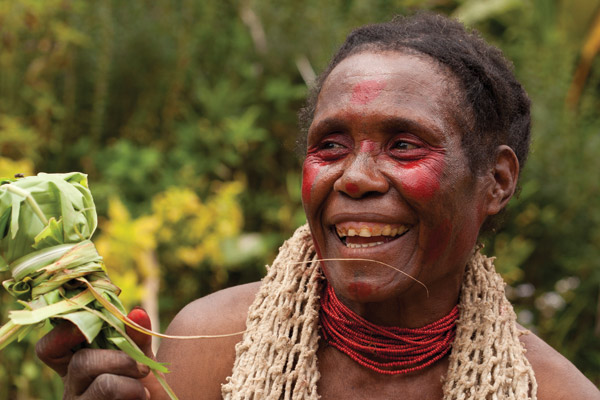 Faces streaked in paint, wearing grass reed skirts and loosely woven fabric over their breasts and heads, three solemn young women stand obediently inside their village gate. One holds a sharp knife; its pointed end facing upwards with red paint at its tip symbolizing blood. Next to her, more easily explained because of unexpected down pours, the girl holds an umbrella. By Kelly Lynch The third woman’s face, neck and arms are caked in white clay. She is in mourning and how long she’ll remain like this depends “how deeply [she] loved her husband,” she says. Her words are interpreted through Alice, a woman from the same village who is helping me understand daily life for women in remote Papua New Guinea. From the air Papua New Guinea’s southern highlands are a mass of verdant jungle randomly separated by deep treeless craters and bounding waterfalls pouring over precipitous cliffs. Carved out of a hillside, 2133 metres above sea-level, hundreds of deep trenches and high mud-block walls enclose clusters of thatched roof huts; their sides woven from wild sugar plants. Tari, blessed with warm days and cool nights, is home to the proud, feisty Huli people. Alice has worked for 14 years at Ambua Lodge. Just out of town its comfortable naturalistic accommodation has views beyond manicured gardens to mountains numerous and undulating. David Attenborough and the BBC film crew stayed here when they filmed some of the 13 Birds of Paradise and their unusual antics in the Tari Gap nearby. Birding guides take early morning and late evening twitcher tours from the lodge into adjacent bush and rainforest passed waterfalls and cane-constructed bridges.  
|