Articles > April/May 2012 > The Real Victims of Rena

|
|
The Real Victims of Rena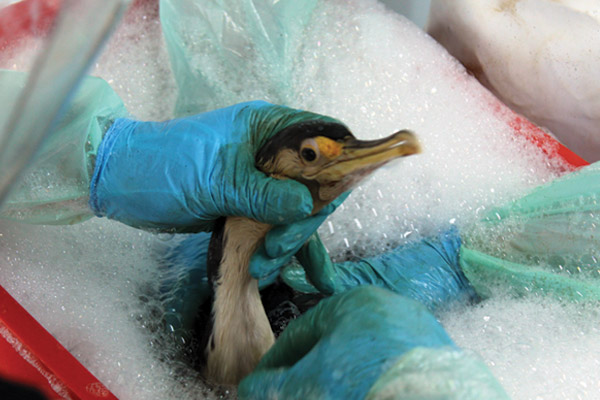 The Real Victims of Rena What happens when one of the richest wildlife habitats in New Zealand is hit with over 350 tonnes oil? One morning last October, Massey University vet Kerri Morgan woke to a call she’d been dreading. A container ship was grounded off Tauranga, holding 1,770 tonnes of crude fuel oil, all of which could potentially leak into the Bay of Plenty – one of the richest wildlife habitats in New Zealand. Having trained for almost 15 years, the National Oiled Wildlife Response Team, which Morgan leads, along with Helen McConnell, was be deployed to its biggest environmental disaster yet. The team was on the scene in Mount Maunganui within hours on October 6 and was able to begin washing the first oiled birds just two days later. Purpose-built facilities housed in a shipping container, and designed and built by Palmerston North’s, Bill Dwyer, formed the basis of the wildlife facility. Soon it became clear that more capacity was needed, and very quickly the facility grew into a tent city including triage, oiled bird holding facilities, a washroom, swimming pools and aviaries for clean birds, and pathology. At its peak the team cared for just over 400 birds, mainly consisting of little blue penguins, but also including shags, petrels, shearwaters, and 60 rare dotterels that were pre-emptively caught. A number of fur seals were also resident at the facility for a few days. Teams of wildlife responders led by the Department of Conservation and other trained personnel scoured the coastline for affected wildlife and brought them back to the centre for treatment. Members of the public were also instrumental in identifying oiled birds at the height of the spill. Kerri says a large team of trained oiled wildlife responders, including ecologists, Regional Council staff from around New Zealand, vets, bird rehabilitators and volunteers, were needed to guide the birds through the centre and back to full health. “Oiled birds that were brought in were checked by a vet to assess vital signs and administer fluids before they were put in a warm environment to stabilise,” she says. “The washing process takes a lot out of a bird so they needed to be rested and strong.” Bryan Gibson Wildlife.massey.ac.nz  
|