Articles > April/May 2012 > Free Radicals

|
|
Free Radicals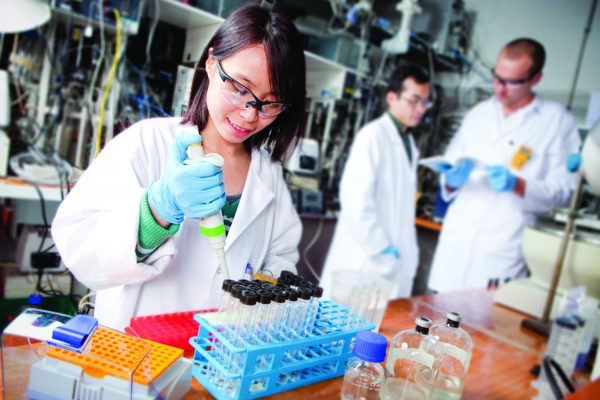 Free Radicals Take New Zealand’s scientific community and you’ve got yourself a small but very capable crowd. Now take out all those with a Y chromosome and the number reduces dramatically. Recognised internationally for their contributions to science, two quiet achievers from New Zealand’s foremost female minds in science demonstrate the power of positive thinking in some less-than-accommodating environments. Professor Christine Winterbourn, MSc (Auckland), PhD (Massey), ONZM, FRSNZ Director of the Free Radical Research Group A cheeky smile flickers across the face of the country’s top scientist, Professor Christine Winterbourn, as she ushers me into her tiny office. “Welcome to the locker room,’’ she says. She’s not kidding! The 2011 Royal Society Rutherford Medal winner actually works from a locker room. She shares the tiny room, dominated by storage units containing lab coats and co-workers’ belongings, with a colleague from the University of Otago as a part of Christchurch’s Free Radical Research Group. Christine Winterbourn is working from these temporary premises because the earthquakes damaged her usual office. But her good-humoured acceptance of the hot, cramped, makeshift office is typical of her unassuming, hard-working style. Christine’s colleagues describe her as an impressive combination of exceptional intellect coupled with an exemplary work ethic. But it’s not just colleagues who appreciate this quiet achiever. The Royal Society of New Zealand recently awarded Christine the country’s top science and technology honour, the Rutherford Medal. She is the first woman to receive the medal in its 20 year history and recognises a career spanning 40 years. In 2004 Christine received the highest research award from the University of Otago, the Distinguished Research Medal, along with being awarded an Anniversary Medal from Massey University where she completed her PhD. These awards add to others she has received from the Royal Society and the Government over the years. The President of the Royal Society of New Zealand, Dr Garth Carnaby, says Professor Winterbourn received the Rutherford Medal because her work in free radical biology paved the way for ground-breaking research into links to diseases. “Professor Christine Winterbourn was one of the first scientists to demonstrate that our cells produce free radicals as part of their normal function. She went on to characterise some of the chemical reactions of free radicals that we now know occur in diseases such as cancer, stroke, coronary heart disease and arthritis,’’ he says. Kim Thomas www.uoc.otago.ac.nz  
|